
Under cabinet lighting is the workhorse that actually lets you see what you are doing on the countertop. The right setup combines the correct fixture type, smart placement, and basic planning for wiring and controls.
Under cabinet lighting is a task and accent lighting system that mounts to the underside of your wall cabinets to illuminate the countertop. In Central New Jersey kitchens, especially older capes and split-levels with smaller windows, this layer of lighting makes a bigger difference than any pendant.
Below is how I talk through under cabinet lighting with homeowners in our Green Brook showroom: what you can choose, where it should go, and how to plan it so your electrician and cabinet layout work together.
1. Main types of under cabinet lighting explained
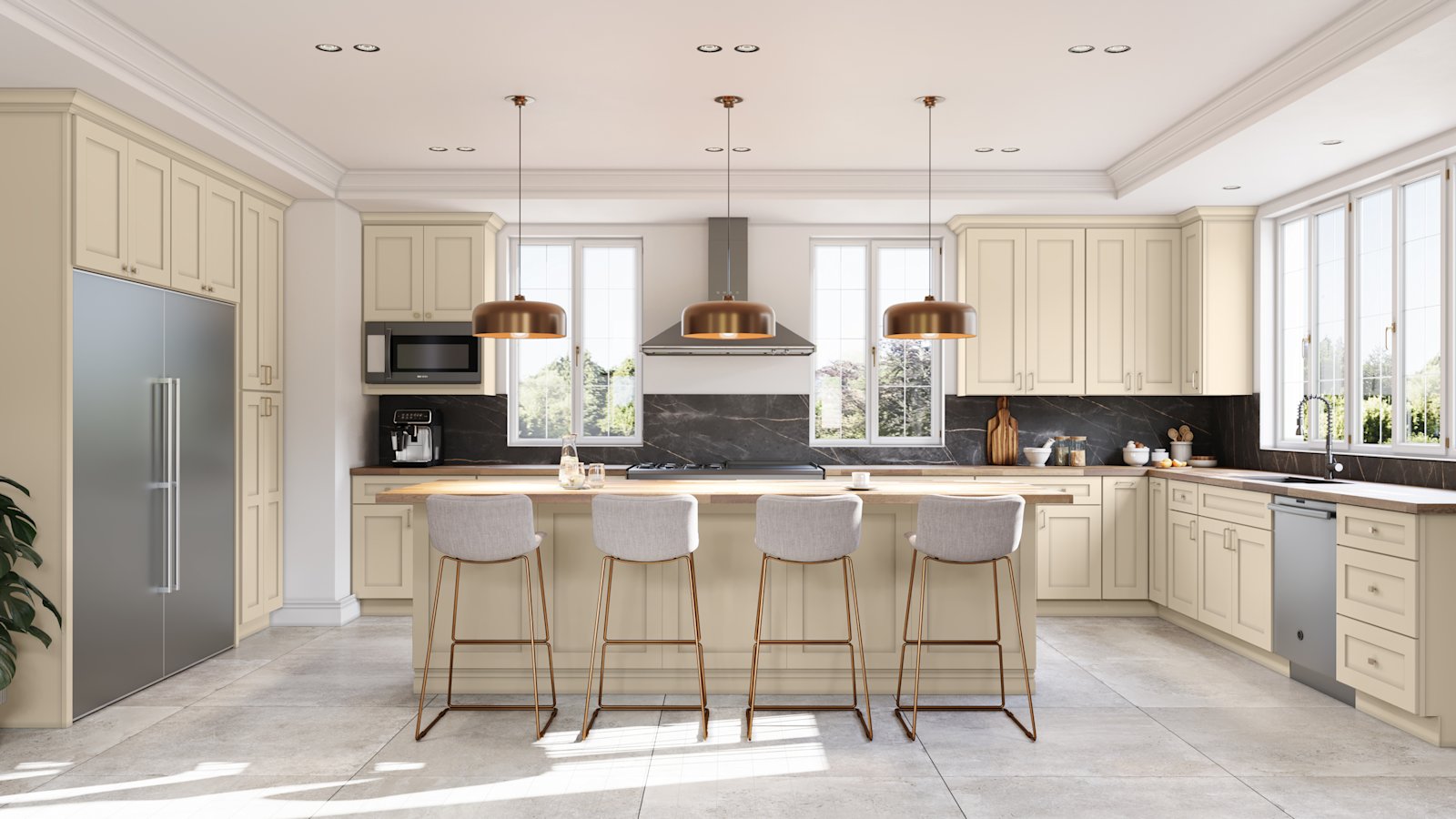
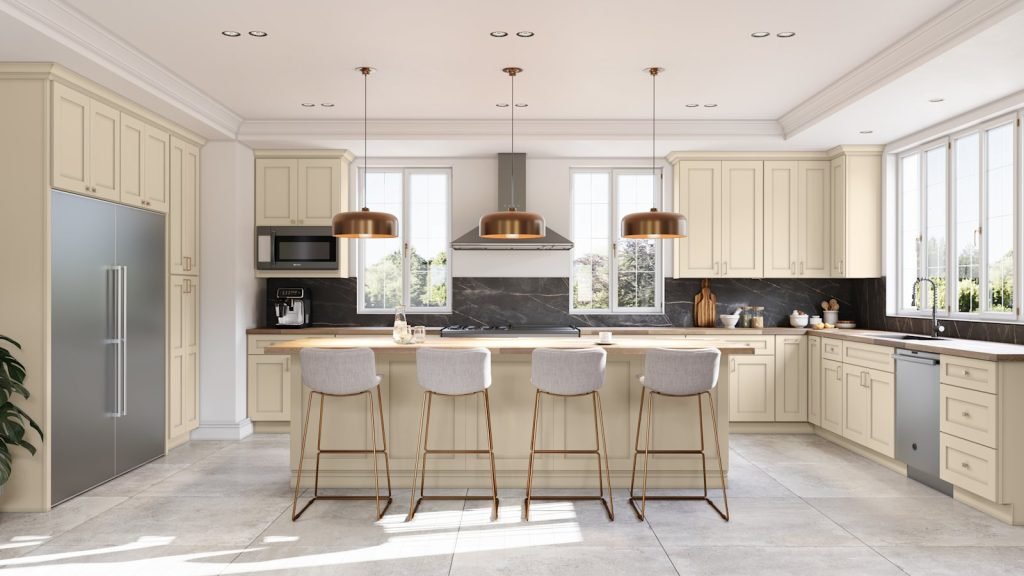 Macadamia Beige classic shaker kitchen cabinets with a dark backsplash, copper dome pendants and stainless appliances. Fabuwood Galaxy.
The main types of under cabinet lighting are LED tape, hardwired bars, puck lights, and modular plug-in systems. Each has a different look, cost profile, and installation requirement.
Common under cabinet lighting types
| Type | What it is | Best for | Pros | Cons |
|---|---|---|---|---|
| LED tape / strip lights | Flexible LED strip on a low-profile track | Even light on long runs | Very low profile, continuous light, efficient | Needs good aluminum channel & diffuser |
| Hardwired LED bars | Rigid bars in set lengths, daisy-chainable | Most standard kitchens | Clean look, easy to service, consistent output | Slightly thicker than tape |
| Puck lights | Small round fixtures spaced along the cabinet | Accent over specific spots | Strong pools of light, good for highlights | Uneven light, can shadow between pucks |
| Modular plug-in systems | Plug-together bars with a transformer and cord | Retrofits without opening walls | DIY-friendly, simple install | Visible cords/outlets, limited layout control |
In most full kitchen remodels, we are using either LED tape in aluminum channels or hardwired LED bars. Pucks are more of a specialty accent now. For New Jersey homeowners who are not opening walls, a high-quality plug-in system is sometimes a practical compromise.
2. How to choose the right under cabinet lighting for your kitchen
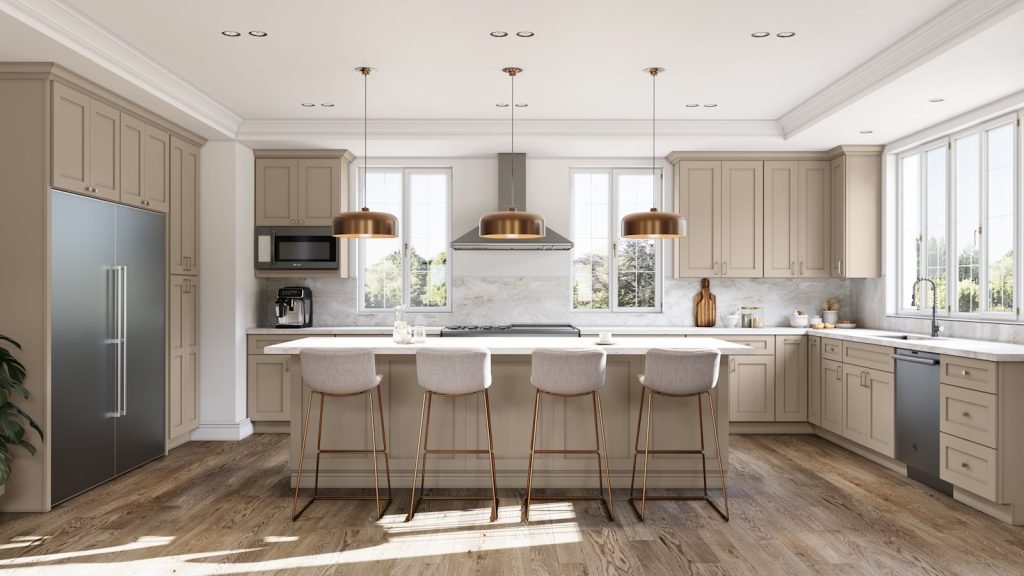 Oyster classic shaker kitchen cabinets with a dark backsplash, copper dome pendants and stainless appliances. Fabuwood Galaxy.
You choose the right under cabinet lighting by matching the fixture type and color to how you cook, your cabinet style, and how much you are opening walls. Start with function, then refine around aesthetics.
For a full gut renovation with new cabinets, a hardwired LED solution almost always makes sense. It gives you a dedicated switch, no dangling cords, and cleaner mounting under Fabuwood or other semi-custom cabinets. LED bars are usually the easiest for the electrician and the most straightforward to service later.
If we are designing a Fabuwood Allure Galaxy or Fusion shaker kitchen, I usually prefer low-profile bars that sit tight to the cabinet frame, so you do not see a bright dot when you sit down. In a frameless kitchen using Fabuwood Illume or Ovela, continuous LED tape in an aluminum channel along the front can look very modern and works well with that sleek door style.
For homeowners doing a light refresh with existing cabinets and no new wiring, we often talk about plug-in LED bars. They are not as clean, but for the right layout they avoid cutting into tile and drywall. During a full kitchen remodeling consultation we will look at how your outlets are placed and whether it is worth upgrading to a wired system as part of the project.
3. Where to place under cabinet lights for the best results
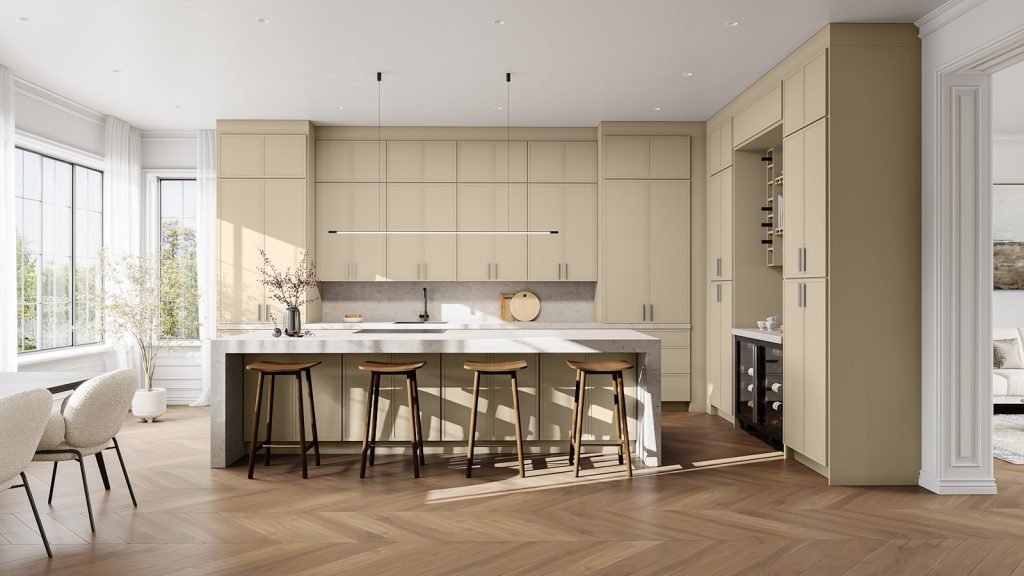 Macadamia Beige slim shaker kitchen cabinets with a contrasting charcoal island, a herringbone wood floor. Fabuwood Luna.
The best place for under cabinet lights is toward the front of the cabinet bottom, directly over the countertop work area, not up against the wall. This minimizes shadows from the cabinet and your body.
On a typical 12 inch deep wall cabinet, I aim to center the fixture 2 to 3 inches back from the front edge. That way the beam spreads across the counter and hits the backsplash without throwing a bright hotspot at your eye. If you mount too far back, you end up lighting the backsplash and leaving the cutting board dark.
In a New Jersey kitchen with variable ceiling heights or soffits, we also watch for open sightlines: if you are seated at a peninsula in a ranch house and can see the underside of the cabinets, the fixture profile and any visible diodes matter more. That is a situation where a frosted lens or a tape light in a proper channel earns its keep.
Consistent placement is important. We want each run to read as one continuous line of light, even across separate cabinets. That means coordinating with the cabinet layout early. When we design cabinet runs, we look at where the under cabinet fixtures will break at a window, range hood, or tall pantry.
4. How bright and what color your under cabinet lights should be
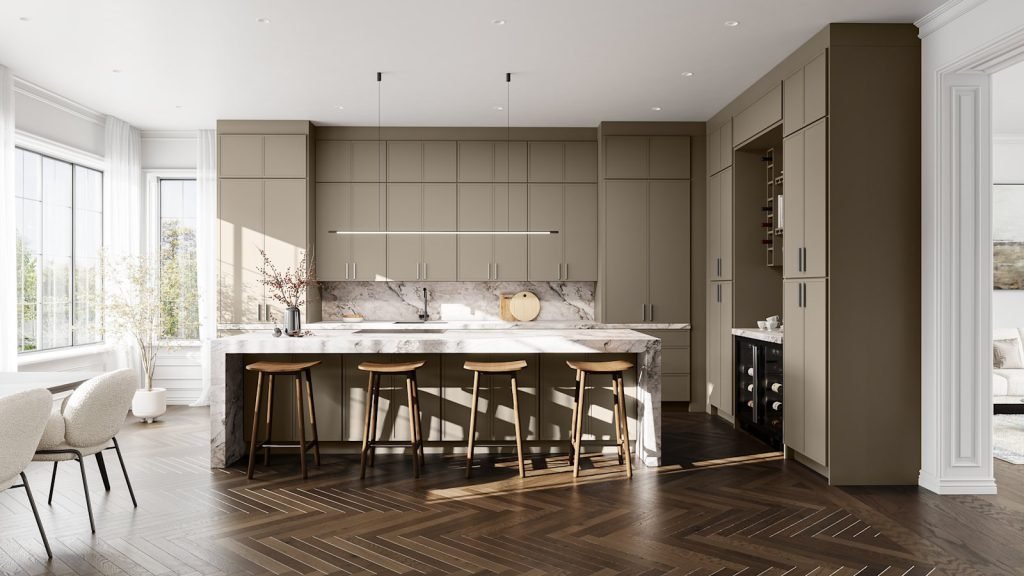 Oyster slim shaker kitchen cabinets with a contrasting charcoal island, a herringbone wood floor. Fabuwood Luna.
Under cabinet lights work best when they are bright enough for safe prep but warm enough to feel comfortable with your cabinets and countertops. Two numbers matter: brightness (lumens) and color temperature (Kelvin), plus color rendering.
For task lighting over the main prep and sink areas, I like to land in the range many pros use: roughly 200 to 500 lumens per linear foot of countertop. The exact spec depends on your ceiling height, paint color, and how much general lighting you have. The National Kitchen & Bath Association provides recommended lighting levels by task, which we use as a guide during layout reviews.
On color temperature, most Central New Jersey kitchens look good in the 2700K to 3000K range. That is a warm white that flatters painted Fabuwood finishes and natural stone-look quartz. Cooler 3500K can work if you have a very modern flat-panel kitchen and want a crisper look, but it will feel a little closer to office light.
Color rendering index (CRI) affects how accurately you see your countertops and food. Look for LEDs with a CRI of 90 or higher so the veining in your quartz and the warmth of wood tones look natural. You are making a sizable investment in countertops, so it is worth pairing them with good light. Sources like the U.S. Department of Energy and ENERGY STAR explain why high-CRI, efficient LEDs are preferred for residential applications.
5. Wiring, switching, and dimming under cabinet lights
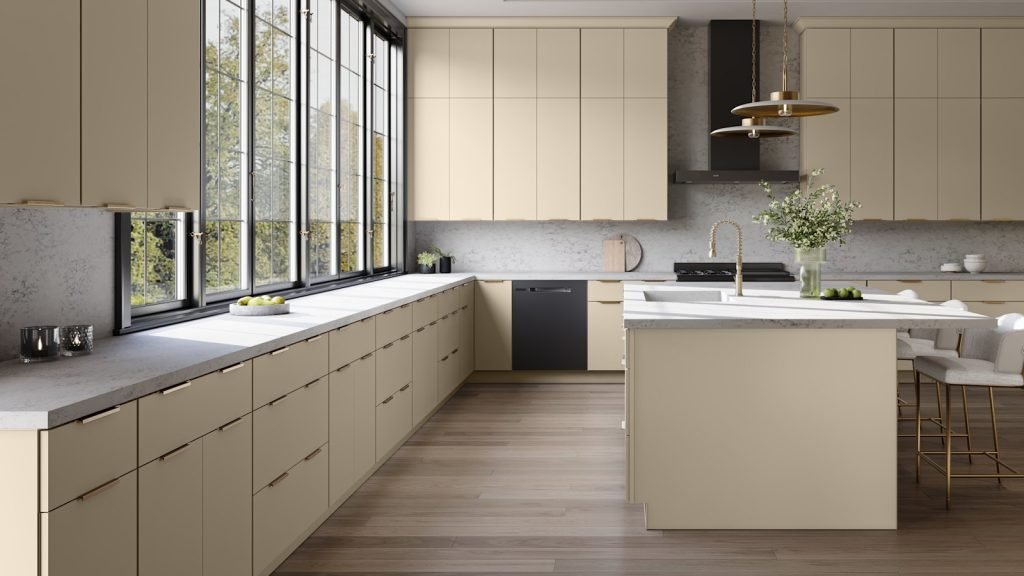 Macadamia Beige flat panel slab kitchen cabinets with white marble counters and island, black framed windows and long brass bar pulls. Fabuwood Luxe.
The cleanest way to wire under cabinet lights is to run power inside the wall to junction boxes behind the cabinets and connect low-profile fixtures that are controlled by a wall switch with an optional dimmer. Planning this early avoids exposed cords and transformers.
For a full remodel, we usually:
- Decide fixture type and layout during the kitchen design phase.
- Mark exact fixture locations on the cabinet plans for the electrician.
- Provide switched outlets or wiring points at the back of the cabinet, often one per run.
- Tie the under cabinet lights to either a dedicated switch or a combined switch with the general recessed lighting, often with separate dimming.
A simple dimmer is worth it. You can run the under cabinet lights at full output for prep, then dim them down for evening or as a night light. That also helps if you chose a slightly brighter system and sometimes want softer ambience.
If we are not opening walls much, we may use a plug-in low-voltage system with a furniture-style cord channel. In that case, we talk about where the transformer will hide and which outlet will feed it, so it does not hang in the middle of the backsplash you just invested in. The New Jersey Department of Community Affairs provides the electrical code framework, and we coordinate with licensed electricians to make sure your plan complies.
For homeowners pricing out a complete remodel, under cabinet wiring is part of the electrical scope we discuss when we review overall kitchen remodeling pricing in New Jersey, because it connects to how many new circuits and boxes you will need.
6. Coordinating under cabinet lighting with cabinets, counters, and backsplash
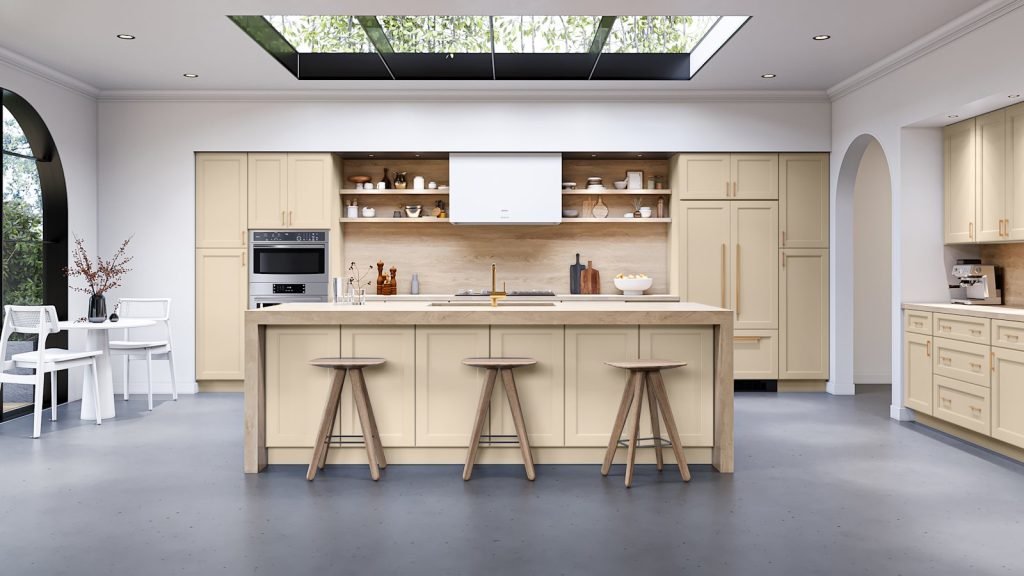 Macadamia Beige transitional shaker kitchen cabinets with a wood-topped island, a skylit room, open shelving and a concrete floor. Fabuwood Fusion.
Under cabinet lighting should be designed as part of a package with your cabinets, countertops, and backsplash so the finishes all read correctly. The same lighting can make a quartz look warm and inviting or cold and flat.
With white or light gray shaker cabinets, under cabinet lights can easily reflect off a glossy quartz or polished tile. In those cases, I like diffused fixtures and careful aiming so you do not see distracting glare when you walk into the room. For darker cabinetry or a textured backsplash, slightly higher output helps the details show.
Countertop material plays a role. A honed quartzite or matte quartz will absorb light differently from a polished surface. As a Cambria or Vadara-style quartz pattern gets busier, even lighting becomes more important so you do not have blotchy areas. When we design a countertop package, we often talk through how under cabinet lighting will hit the veining and seams.
Tile can be another driver. If you are using a glossy subway tile from your tile and flooring selection, an LED bar placed properly toward the front edge of the cabinet will wash the tile evenly and minimize bright hotspots. With a handmade or textured tile, under cabinet lighting will emphasize every ridge. Some homeowners love that, others prefer a softer effect, which we can manage with fixture choice and dimming.
In older New Jersey homes, walls are rarely perfectly straight. That means the underside of the cabinets can vary slightly relative to the backsplash plane. We pay attention to that when we place fixtures so minor waves in the wall do not become obvious as rippling lines of light.
7. Planning under cabinet lighting in a New Jersey kitchen remodel
 Oyster transitional shaker kitchen cabinets with a wood-topped island, a skylit room, open shelving and a concrete floor. Fabuwood Fusion.
Planning under cabinet lighting in Central New Jersey starts with your layout and existing electrical, then folds into your cabinet and backsplash design so everything is coordinated from day one.
In our Green Brook Township showroom, we typically walk through under cabinet lighting as part of a full kitchen remodeling discussion, not as an afterthought. We look at your existing kitchen photos and layout, talk about which walls will be opened, and decide whether you are better off with fully hardwired LEDs or a hybrid solution.
If you are starting a Bronze or Silver level cabinet and countertop project from Savona, we can still plan for under cabinet lighting locations and hand those details to your electrician. For Gold and Custom level kitchen packages, our in-house installation team coordinates directly with your lighting plan as part of the full installation scope, while making sure all work aligns with New Jersey code and inspection requirements.
Flat-panel and frameless lines like Fabuwood Illume and Ovela often pair nicely with continuous LED channels. More traditional raised panel or shaker cabinets might benefit from discrete bars that visually disappear. In either case, the earlier we talk about it in the design process, the cleaner and more integrated the finished result.
If you are considering a remodel anywhere in Central New Jersey, from Bridgewater and Basking Ridge to Belmar or Aberdeen, under cabinet lighting is something we can lay out right in your plan set so your project runs smoothly.
Frequently asked questions
How many under cabinet lights do I actually need?
You need enough under cabinet lighting to provide even coverage across each countertop run, not a specific number of fixtures. For most kitchens, that means one continuous bar or tape strip per cabinet run, sized to match the cabinet length. Your designer and electrician will size the wattage and spacing so you do not see dark gaps or very bright spots.
Should under cabinet lights be on their own switch?
It is best if under cabinet lights have at least their own dimmer, even if they share a wall box with the main ceiling lights. Independent control lets you run just the under cabinet layer as a night light or mood lighting, and turn everything up when you cook. In a remodel, planning the switching early avoids extra patching later.
Are plug-in under cabinet lights good enough, or do I need hardwired?
Plug-in under cabinet lights can be perfectly fine for a light refresh or a condo where you are not opening walls. You will see more cords and transformers, and control options are more limited. In a full remodel where walls are open, hardwired low-voltage LEDs with a wall switch and dimmer usually look cleaner and feel better to live with.
Do under cabinet lights go in before or after the backsplash?
The wiring and any junction boxes go in before cabinets and tile. The actual fixtures are typically installed after cabinets are up but before or just after tile, depending on the system. The crucial piece is to have the layout decided early so the electrician does not need to cut through finished backsplash to make changes.
Will under cabinet lighting heat or damage my cabinets?
Modern LED under cabinet fixtures produce very little heat compared with older xenon or halogen lights. When you choose UL-listed LED products and have them installed correctly, they are safe to use under Fabuwood and other semi-custom cabinets. We avoid older high-heat technologies precisely to protect finishes and extend fixture life.
Conclusion: Next steps for planning under cabinet lighting
A good under cabinet lighting plan is less about the latest gadget and more about coordination: fixture type, placement, wiring, and how it all works with your cabinets and counters. If you are starting to plan a kitchen in Central New Jersey, the simplest next step is to share your layout and a few photos.
You can request a free estimate and talk through under cabinet lighting options along with cabinets and countertops, or book an appointment at our Green Brook showroom to see finishes and lighting in person. Our team designs, supplies, and installs complete kitchens throughout our Central New Jersey service area, and under cabinet lighting is always part of that conversation.


