
Quartz backsplash pros and cons come down to cost, cleaning, and how careful you are with heat. In many New Jersey kitchens a quartz backsplash is a great, low‑maintenance choice, but it is not the right fit for every cooking style or budget.
Quartz backsplash is a man‑made stone surface, made from ground natural quartz and resins, that extends up the wall behind your counters. As a working kitchen designer in Green Brook, I see homeowners choose it either as a short 4 inch “counter extension” or as a full-height slab to the cabinets. Let’s walk through the real tradeoffs so you can decide where quartz makes sense in your own layout.
1. Quartz backsplash cost vs tile cost
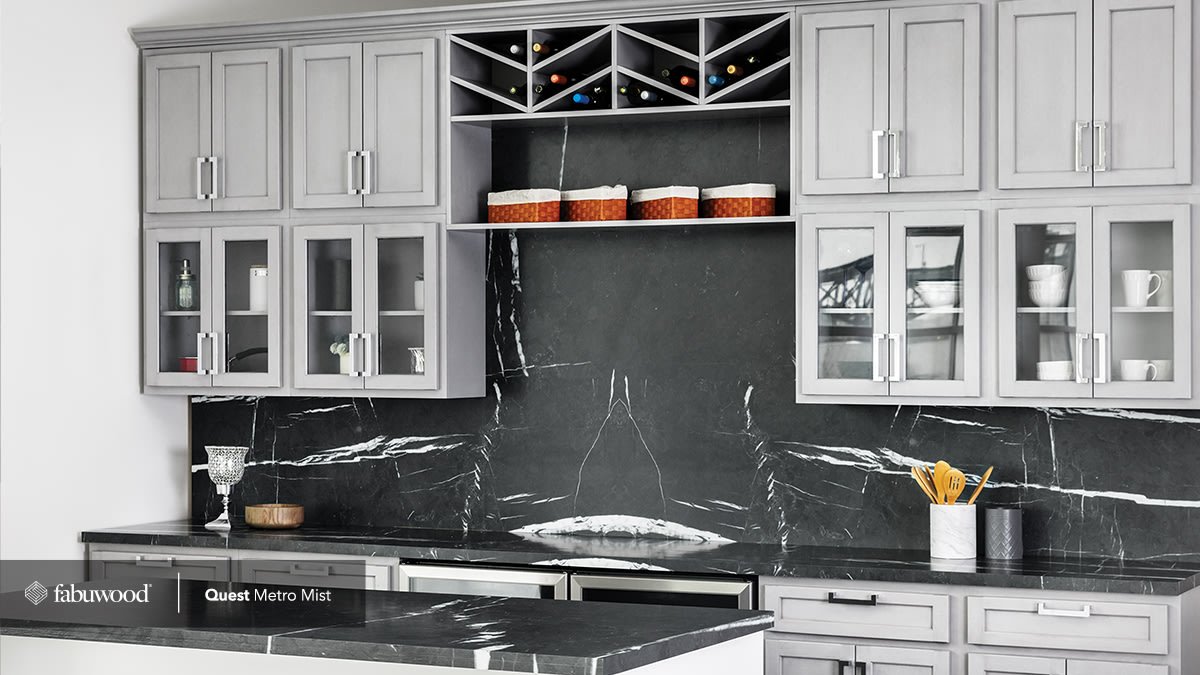
 Mist traditional shaker kitchen cabinets with a black marble backsplash and black counters, glass front upper cabinets and a wine rack. Fabuwood Metro.
Quartz backsplash usually costs more upfront than tile, but less than many natural stone slabs once you include labor. The exact number depends on the brand you choose, how much wall you cover, the number of outlet cuts, and how tricky your layout is.
At Savona we work with Cambria, LX Hausys, Vadara Quartz and MSI Surfaces, so most homeowners are looking at mid to upper mid‑range pricing, not entry level. Your final cost will also track your countertop choice, since most people use the same material for both. That is why our Silver and Gold kitchen packages, starting at $9,999 and $14,999, include a countertop package, with final pricing based on layout, materials, cabinet line and installation scope.
Here is a simple comparison of how quartz backsplash usually compares with a typical tile backsplash in New Jersey projects.
| Feature | Quartz Backsplash | Tile Backsplash |
|---|---|---|
| Material cost | Higher per square foot | Lower to moderate per square foot |
| Labor cost | Fewer seams, but needs a fabricator | More pieces, grout, more labor hours |
| Small kitchen total | Often competitive with nicer tile | Often lowest cost overall |
| Large kitchen total | Can add up quickly | More flexible to control budget |
| Change later | More expensive to replace | Easier to remove and retile |
Homeowners in Central New Jersey with compact galley or L‑shaped kitchens sometimes find that a quartz slab backsplash falls within reach when they run the numbers against a premium tile with detailed layout. In larger open‑plan spaces with long runs and tall ceilings, tile usually wins on budget flexibility.
If you are just exploring what is realistic overall, the kitchen remodeling pricing guide for New Jersey projects is a good place to see how backsplash fits into total cost, rather than treating it as a separate project.
2. Cleaning and maintenance of a quartz backsplash
 Basalto handleless flat slab kitchen cabinets with white marble counters and island, copper dome pendants and built-in black ovens. Fabuwood Catalina.
Quartz backsplash is one of the easiest backsplash materials to keep clean. You have a smooth, non‑porous surface with no grout lines, which is a huge advantage behind a busy cooktop or sink.
Most engineered quartz is stain resistant and does not need sealing, unlike many natural stones. That is why you see it recommended so often in durability tests from independent groups such as Consumer Reports. Day to day, a mild dish soap and soft cloth are usually all you need.
In real New Jersey kitchens where humidity swings between seasons and families actually cook, fewer seams and no grout means less chance of grease and moisture settling into joints. Behind a range, that can make the difference between a 10‑minute wipe down and scrubbing stained grout. For very heavy tomato, wine, or curry splashes, it still pays to wipe soon rather than letting them sit overnight.
3. Heat resistance and where quartz can burn
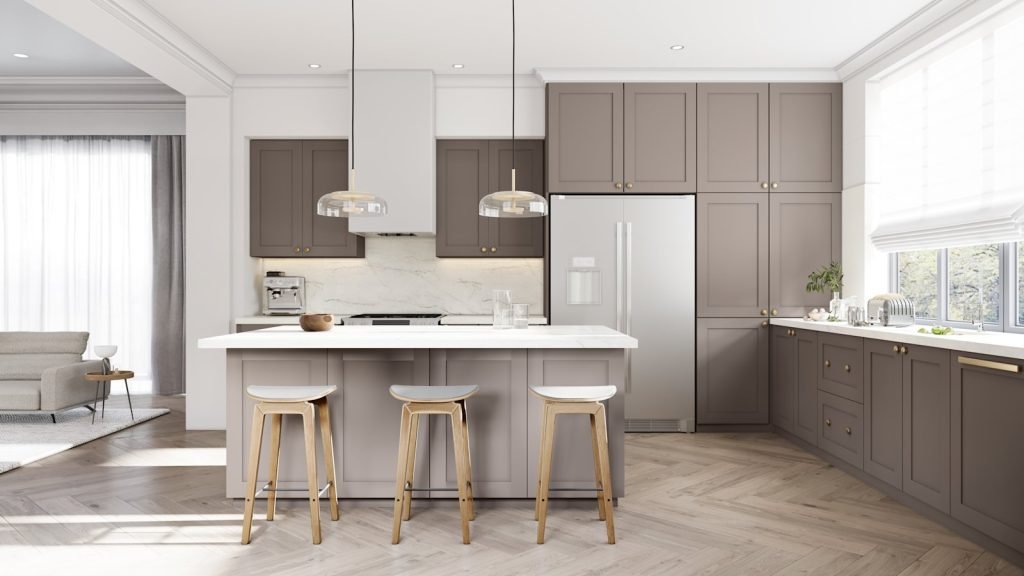 Basalto frameless wide shaker kitchen cabinets with a white perimeter and island below contrasting tall cabinetry, a marble backsplash and a wood floor. Fabuwood Tuscany.
Quartz backsplash handles normal kitchen heat, but direct high heat can discolor or scorch it. The resins that bind the quartz aggregate can start to break down at sustained high temperatures, which is why manufacturers warn about hot pots and high‑output burners.
Most quartz suppliers recommend at least a few inches of clearance between the burner flame or electric element and the quartz surface on the wall. Very high‑BTU professional‑style ranges, or a gas cooktop pushed tightly against a side wall, deserve a closer look during design. For those situations, some homeowners switch to tile or a stainless panel just behind the range and use quartz on the rest of the walls.
Building codes in New Jersey also set clearances and combustible / non‑combustible surface requirements around ranges, which your installer and your local building department will review. The New Jersey Department of Community Affairs maintains the adopted codes and updates, which is what fabricators and contractors follow in the field.
If you cook a lot with woks or cast‑iron searing and like to crank burners up on the front, it is worth talking through exact clearances during your kitchen remodeling consultation rather than assuming any backsplash material will be fine.
4. Design impact of a quartz backsplash in your kitchen
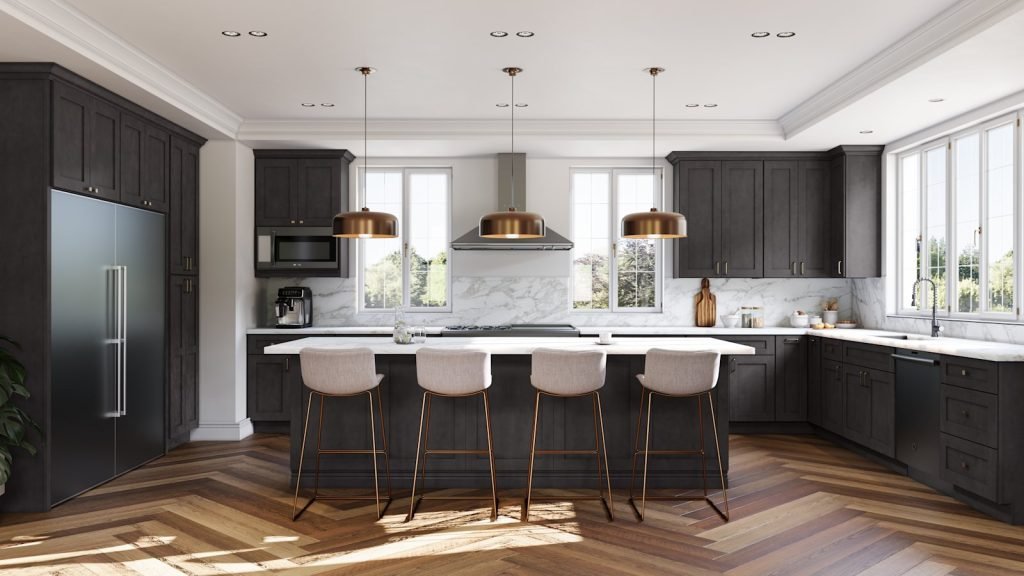 Cobblestone classic shaker kitchen cabinets with white marble counters and island, copper dome pendants and stainless appliances. Fabuwood Galaxy.
A quartz backsplash gives a clean, continuous look and lets the cabinets and counters stay the focus. Because the pattern simply continues from the countertop, the whole run reads as one surface instead of a busy mix of materials.
In our Green Brook showroom, homeowners who gravitate toward simple cabinet doors, like a shaker style from Fabuwood’s Allure series or a flat slab in a frameless line, often like the way a slab backsplash supports that streamlined look. It works especially well with white and light gray quartz patterns that mimic marble without the maintenance.
On the other hand, if you want the backsplash to be the star of the kitchen, patterned or textured tile usually gives you more visual interest for less money. A quartz backsplash is more about calm and continuity than it is about color or intricate pattern.
Another design advantage is alignment. With quartz, we can line the veining up between counter and wall so it flows across the corner, or run the same material behind floating shelves for a built‑in look. In older Central New Jersey homes where walls can be a bit wavy, a solid slab can hide imperfections that might show through a large format tile.
5. Installation details and layout limitations
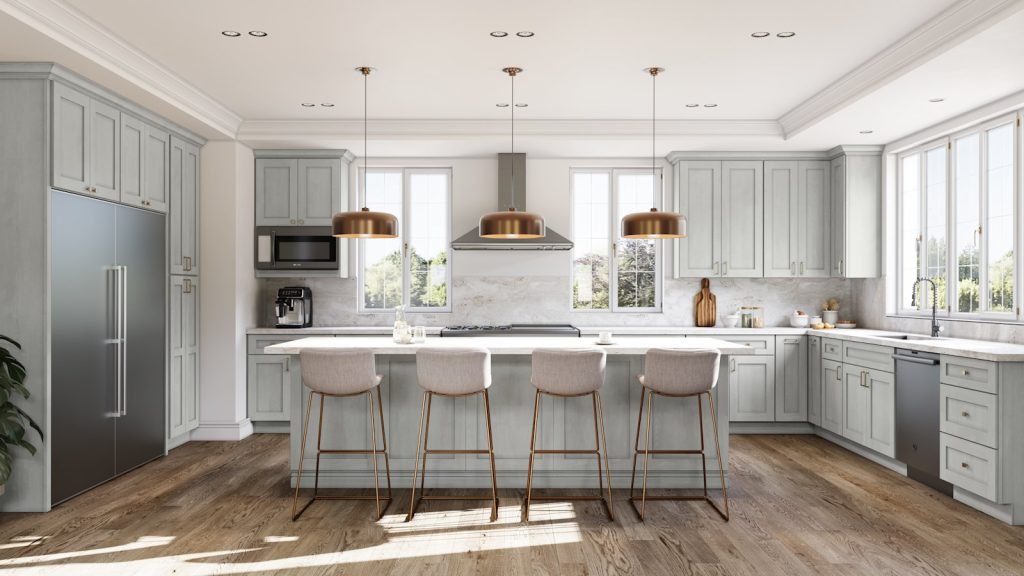 Horizon classic shaker kitchen cabinets with white marble counters and island, copper dome pendants and stainless appliances. Fabuwood Galaxy.
Quartz backsplash installation is more like countertop work than like tile, and it comes with some constraints. Your backsplash pieces are templated, cut and polished by a countertop fabricator, then installed in larger sections rather than one tile at a time.
Large pieces are heavy and rigid, which can be an issue in tight New Jersey homes with narrow stairs or tight turns. Sometimes we plan for more seams or smaller sections just to get them into the house safely. Out‑of‑square walls, bowed framing and uneven plaster also matter, because a stiff slab will not flex to follow a crooked wall the way tile can.
You also need solid planning for outlets, switches and undercabinet lighting. Each cutout must be measured and fabricated accurately. Moving a box a couple of inches after the slab shows up is not simple. That is why we usually coordinate backsplash decisions during the main kitchen remodeling design phase, not as an afterthought.
For homeowners working with their own contractor, a cabinets‑only package starting from $4,999 can be paired later with a separate countertop and backsplash contract. Just remember that each change you make downstream can cascade into new templates and trip charges, so it pays to decide on quartz vs tile early.
6. Durability, staining and long‑term performance
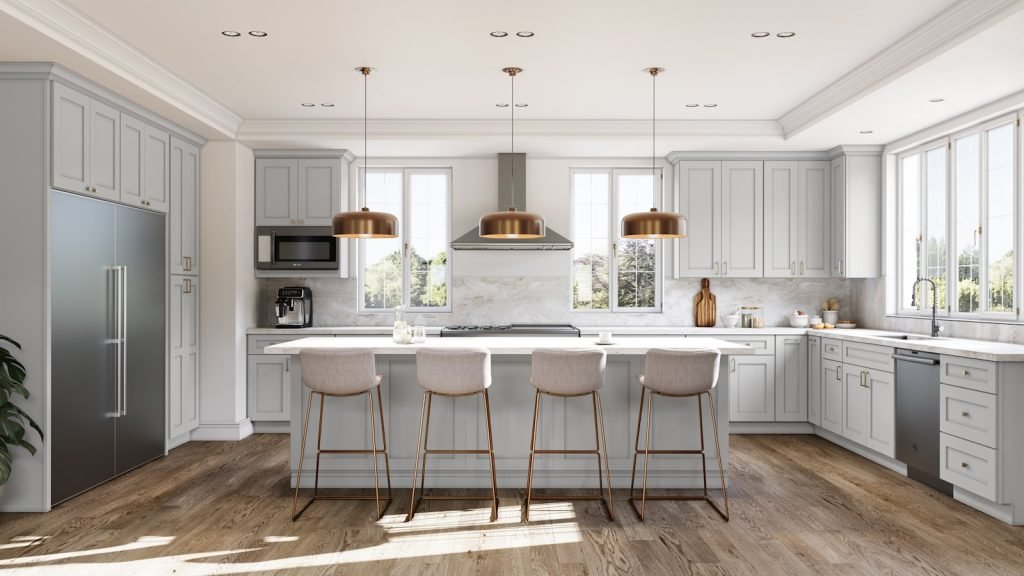 Nickel classic shaker kitchen cabinets with white marble counters and island, copper dome pendants and stainless appliances. Fabuwood Galaxy.
Quartz backsplash is very durable in normal use and one of the most forgiving surfaces you can put on a vertical wall. Since it is not a work surface, you are not cutting on it or dropping heavy pots against it, so chips and scratches are less common than on a countertop.
The non‑porous surface resists most household stains better than many natural stones, which aligns with testing data you will see from groups like the Natural Stone Institute, even though they focus on stone rather than engineered quartz. Oils, coffee and splashes that might darken some marbles typically wipe off quartz without a trace if you address them in a reasonable time.
Over many years, direct UV exposure can slightly affect color in some quartz products, so heavy sun through a south‑facing New Jersey kitchen window is something to talk through when we look at samples. Interior runs under wall cabinets rarely see enough UV to matter, but full‑height slabs near tall windows or sliders deserve a closer look.
The other factor in long‑term performance is how the seams and edges are detailed. A good fabricator will treat your backsplash like a countertop, with properly finished edges and carefully matched seams. Poor adhesive choice or sloppy caulking at the counter joint can collect grime or separate over time, so installation quality matters at least as much as the product itself.
7. How quartz backsplash compares to other backsplash options
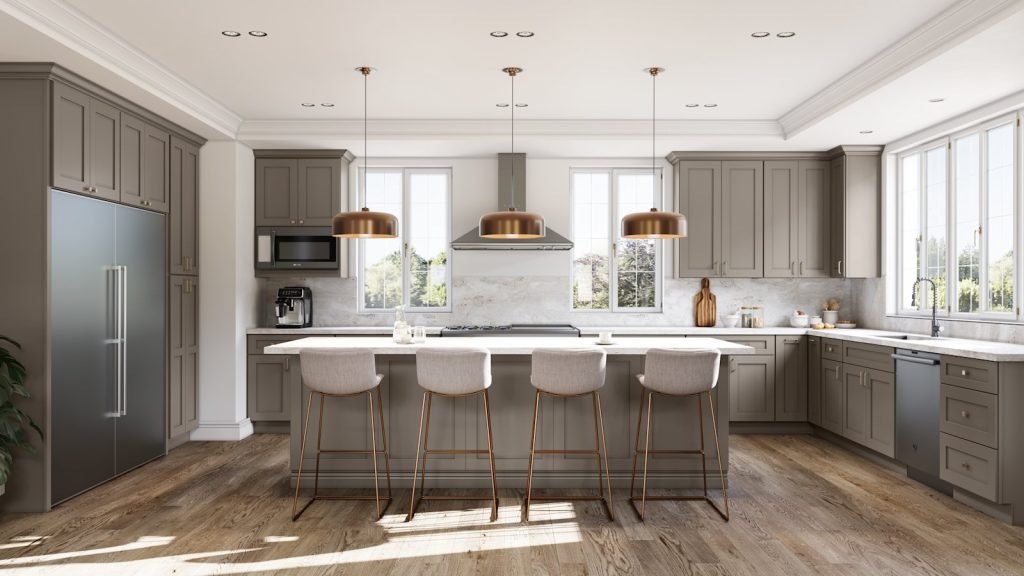 Stone classic shaker kitchen cabinets with white marble counters and island, copper dome pendants and stainless appliances. Fabuwood Galaxy.
Quartz backsplash is best viewed alongside tile, natural stone, and stainless so you can see where it fits your priorities. In Central New Jersey, tile still leads for sheer variety and budget control, but quartz has been gaining ground in modern and transitional kitchens.
Here is a side‑by‑side comparison you can use as a starting point.
| Option | Pros | Cons | Best for |
|---|---|---|---|
| Quartz slab | Very easy to clean, no grout, unified look with counters | Higher cost, heat limits near powerful ranges, less decorative variety | Busy cooks who want low maintenance and a clean look |
| Tile (ceramic / porcelain) | Huge style range, good budget control, easy to repair sections | Grout cleaning, more joints for grease and splatter | Most kitchens where design flexibility matters |
| Natural stone (marble, granite) | Unique veining, high‑end look | More sealing and maintenance, more sensitive to stains or etching depending on stone | Accent walls or feature ranges |
| Stainless or glass | Highly heat tolerant (stainless), contemporary look | Shows fingerprints (stainless), can feel cold visually | Small focal areas behind high‑BTU ranges |
In practice, many homeowners mix materials. You might run quartz up 4 inches everywhere, then add tile above, or use full‑height quartz on the sink wall and tile behind a high‑output range. Because we design the whole kitchen as a package, including cabinets, counters, backsplash and flooring, we can mock up those combinations during your design consultation.
If you are comparing quartz against other counter materials at the same time, the countertop section of our site walks through the pros and cons of quartz and quartzite as full work surfaces, which usually track closely with how they behave as a backsplash.
Frequently asked questions
Is a quartz backsplash worth the money?
It is worth the money if you value easy cleaning, a quiet modern look and matching your counters. In many small to mid‑size New Jersey kitchens, the total cost is closer to a nicer tile job than people expect, especially with fewer grout lines to maintain. For large kitchens or very tight budgets, tile usually stretches dollars further.
Can quartz backsplash go behind a gas range?
Yes, quartz backsplash can go behind a gas range if you respect the manufacturer’s heat clearance guidelines and local code. The key is keeping direct flame and extreme heat off the surface. For powerful ranges or tight side clearances, we sometimes add a stainless or tile panel just in the highest heat zone and use quartz elsewhere.
Does quartz backsplash stain or yellow over time?
Quartz backsplash is very stain resistant for everyday splashes and generally does not yellow indoors under normal lighting. Long‑term exposure to strong UV light through big windows can affect some products slightly, so we review sample performance for sunny locations. Regular wiping with mild cleaners is usually all the maintenance you need.
Is quartz or tile better for a backsplash?
Quartz is better if you want the lowest maintenance and a clean, uninterrupted look that matches your counters. Tile is better if you want more pattern, texture, color and budget control. Many Central New Jersey homeowners still choose tile because of the design flexibility, but quartz has become popular in modern and transitional kitchens.
Can I add a quartz backsplash later if I already have counters?
You can add a quartz backsplash later, but it is more efficient to plan it with your countertop installation. The fabricator needs to match color, thickness and seams, so using the same supplier helps. Retrofitting can mean extra site visits, templates and trip charges, which is why we usually coordinate everything during the main kitchen remodeling project.
Next steps for choosing a quartz backsplash in New Jersey
If you are weighing the pros and cons of quartz backsplash for a Central New Jersey kitchen, the next step is to see real slabs and door samples together. Our Green Brook Township showroom lets you pair quartz options from Cambria, LX Hausys, Vadara and MSI with cabinet lines like Fabuwood so you can see how the backsplash decision plays with the rest of the room.
Every starting price we mention is a baseline; final kitchen costs depend on your layout, cabinet line, countertop and backsplash material, and the installation scope. Demolition, electrical, plumbing rough‑ins, flooring, tile and structural changes are always additional. If you would like a realistic number for your home rather than a generic range, you can request a free estimate and share your layout or schedule a time to sit down in the showroom.
That conversation usually answers the quartz vs tile question quickly once we see your range, window placement and how you actually cook.


