
Countertop edge profiles affect how a kitchen looks, feels, cleans, and holds up around busy work areas. For most Central New Jersey kitchens, an eased edge is the practical default, while bullnose, ogee, and waterfall details make sense when the cabinet style, slab material, and budget support them.
A countertop edge profile is the shaped and finished edge of a countertop slab that determines its visible outline, corner feel, and visual weight. It may seem like a small fabrication choice, but the profile can make a slim-shaker kitchen feel crisp and current or make a traditional kitchen feel more formal.
The best way to choose is to look at the actual cabinet door, countertop sample, hardware, and lighting together. Homeowners can compare those materials side by side at Savona Kitchen & Bath’s Green Brook Township showroom before committing to a profile.
What are the most practical countertop edge profiles for a kitchen?
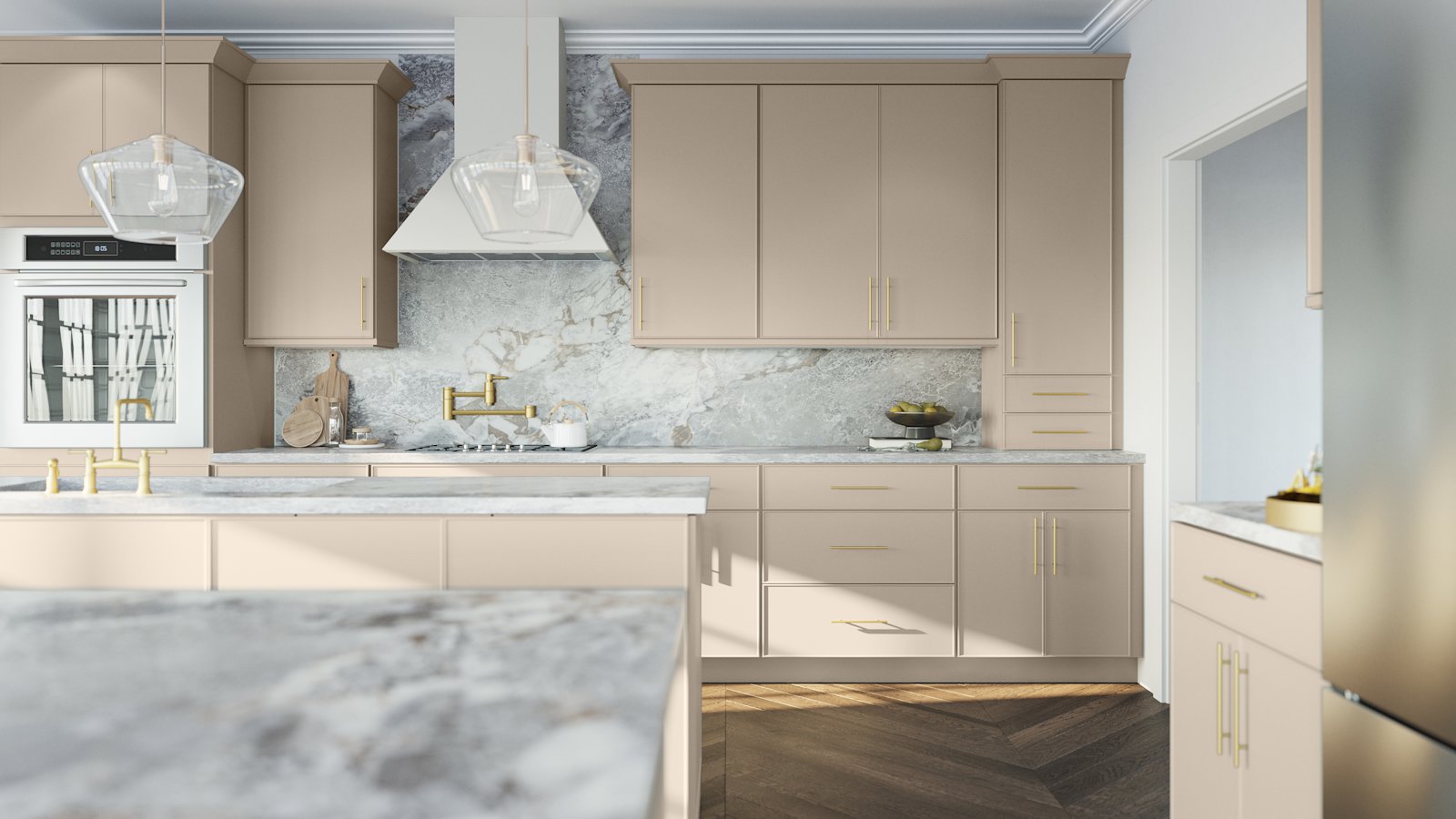
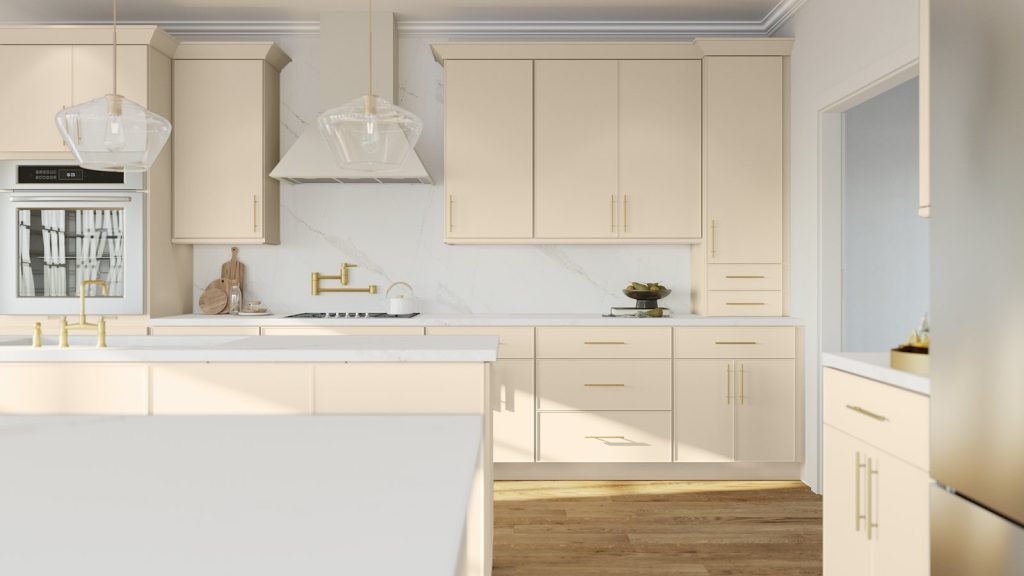 Macadamia Beige micro shaker kitchen cabinets with white marble counters and island, slim brass hardware and a light wood floor. Fabuwood Echo.
The most practical countertop edge profiles for a kitchen are eased, pencil-round, and bullnose because they are comfortable to use, easy to wipe down, and compatible with many cabinet styles. Ogee and waterfall edges are more decorative choices that work best when the kitchen design calls for a stronger visual statement.
An eased countertop edge has a lightly softened square edge. It still reads clean and straight from across the room, but it removes the sharpness that makes a true square edge uncomfortable. It works especially well with flat-panel cabinets, slim shaker doors, and modern hardware.
A pencil-round edge has a slightly more noticeable curve than an eased profile. It suits transitional kitchens where the homeowner wants a softer detail without going fully traditional. Bullnose has a rounded front edge and is forgiving in family kitchens because there is no hard corner along the counter face.
An ogee countertop edge is more sculpted, with an S-shaped curve that catches light and shadow. It generally fits raised-panel doors, detailed moldings, traditional hardware, and more formal spaces better than a simple contemporary shaker kitchen.
A waterfall countertop edge is different from the other countertop edge styles because it is not just a shaped slab edge. The countertop material continues down the side of an island or cabinet run, creating a vertical stone or quartz panel. It is a design feature rather than a standard perimeter-edge choice.
How do countertop edge styles change the look of cabinets?
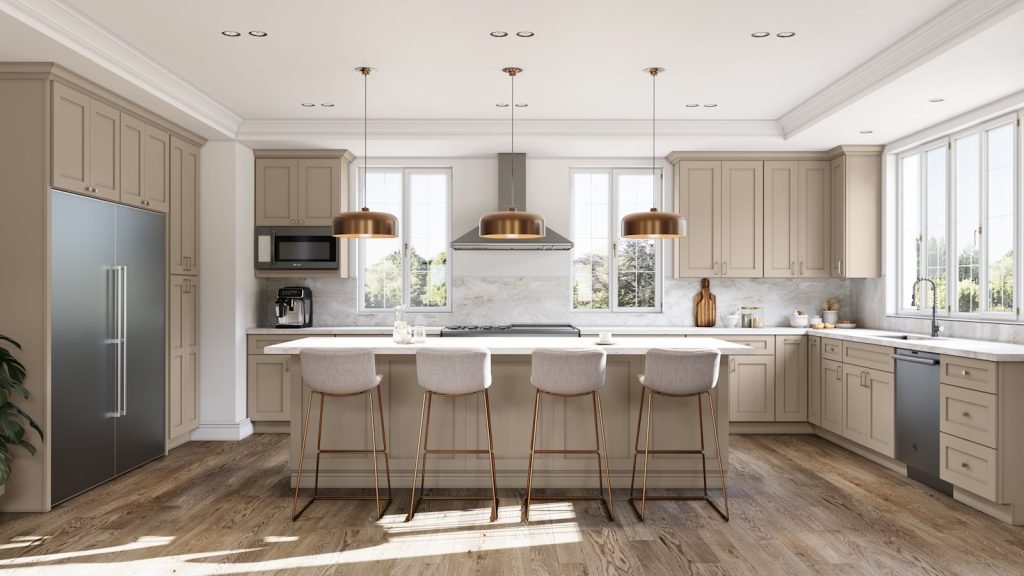 Oyster classic shaker kitchen cabinets with a dark backsplash, copper dome pendants and stainless appliances. Fabuwood Galaxy.
Countertop edge styles change the apparent weight and formality of cabinetry because the edge is seen directly above every door and drawer. Thin eased profiles make cabinets look more tailored, while rounded and decorative profiles add softness, depth, and a more traditional furniture-like appearance.
For a clean kitchen, picture warm white shaker cabinets, a pale quartz counter with subtle movement, brushed metal pulls, and an eased edge. The edge lets the countertop read as a calm horizontal line rather than a decorative band. That combination works naturally in many older colonials, ranches, and split-level homes around Bridgewater, Hillsborough, Somerville, and Warren.
A more formal room might use painted raised-panel cabinets, a warmly veined quartzite surface, darker hardware, and an ogee edge. The carved edge creates a deeper shadow line, which can help a thicker-looking countertop feel intentional beside more detailed cabinetry.
Fabuwood offers framed cabinet options in Allure, Quest, and Value Premium, along with frameless Illume and Ovela collections. A simple profile often complements the cleaner lines of frameless cabinetry and slab doors, while a more detailed profile can be appropriate with traditional framed door styles. The cabinet construction does not dictate the edge, but the two should look designed together.
Which countertop edge profile is easiest to clean and live with?
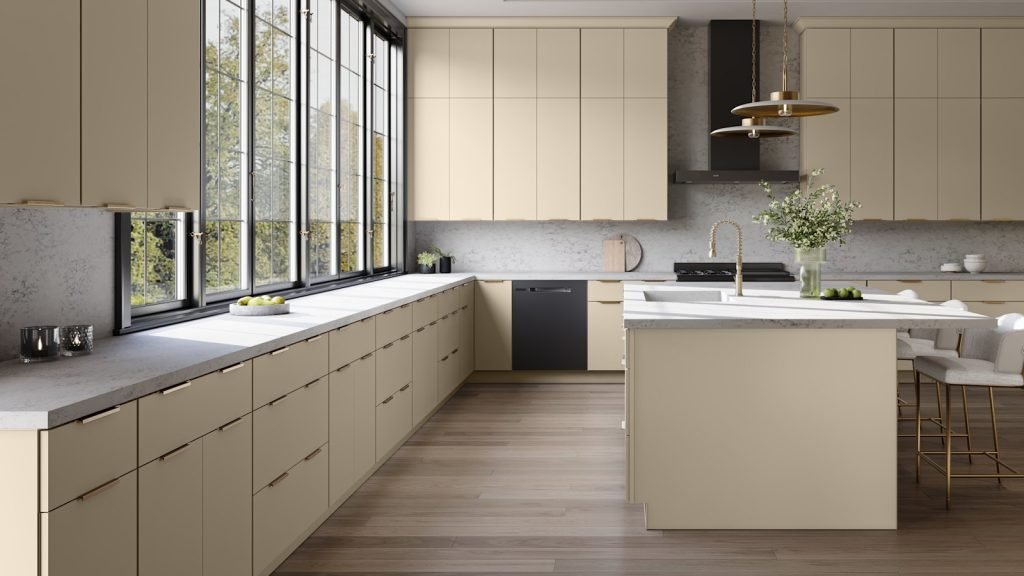 Macadamia Beige flat panel slab kitchen cabinets with white marble counters and island, black framed windows and long brass bar pulls. Fabuwood Luxe.
An eased edge is usually the easiest countertop edge profile to clean and live with because its shallow softened corners do not collect much residue or create intricate grooves. A pencil-round or bullnose edge is also practical, while ogee profiles need more attention around their recessed curves.
Kitchen counters receive crumbs, drips, cooking oil, and hand contact every day. An eased edge can be wiped quickly from the top surface over the front edge. A rounded bullnose edge is similarly simple, although its fuller curve changes the visual thickness of the slab.
Ogee and layered edges are not difficult to maintain, but they have more shape. Flour, dust, or residue can settle in the curved transition if the edge is not wiped regularly. That does not make decorative profiles wrong, but homeowners should choose them for the look they want rather than expecting the same low-maintenance feel as a straightforward eased edge.
For natural stone, care also depends on the stone itself, not only the edge. The Natural Stone Institute’s consumer guidance explains that natural stone maintenance varies by material and use. Quartz and quartzite are the surfaces Savona works with most, and the right edge should be selected after looking at the actual slab or sample.
Countertop edge profile comparison
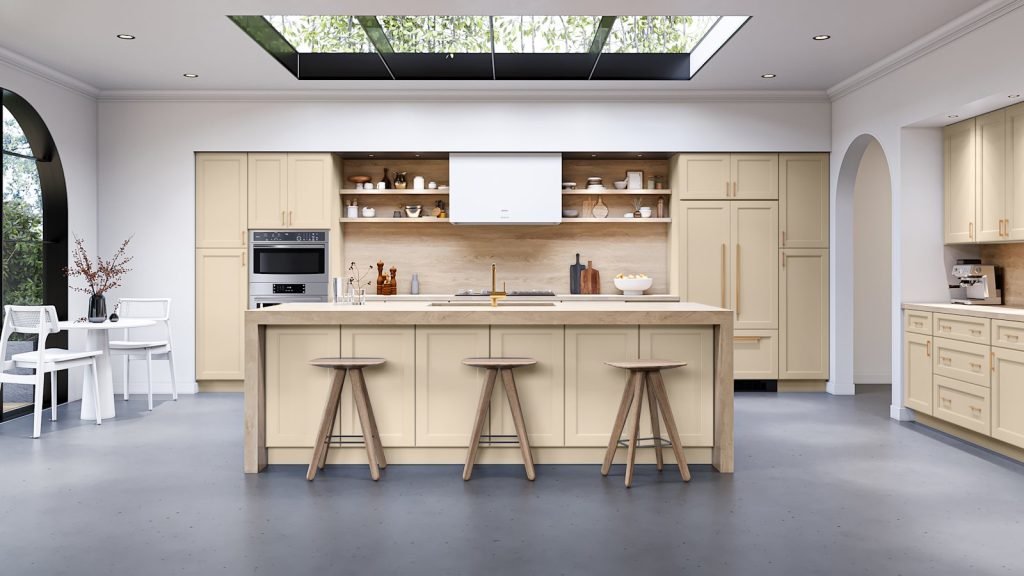 Macadamia Beige transitional shaker kitchen cabinets with a wood-topped island, a skylit room, open shelving and a concrete floor. Fabuwood Fusion.
The right countertop edge profile depends on the desired style, how the kitchen is used, and whether the countertop is a simple perimeter run or a feature island. Eased, bullnose, ogee, and waterfall options solve different design problems, so one profile is not universally better than another.
| Edge profile | Best fit | Practical considerations |
|---|---|---|
| Eased | Modern, transitional, shaker, slab-door kitchens | Easy to clean, visually light, and suitable for most countertop materials |
| Bullnose | Family kitchens, softer transitional designs | Rounded feel with no sharp front corner; can make the slab appear thicker |
| Ogee | Traditional kitchens with detailed doors or molding | Decorative and formal; grooves need more careful wiping |
| Waterfall | Contemporary islands and statement layouts | Extends the material down the cabinet side; requires careful slab planning and fabrication |
Eased edge verdict: Choose an eased edge when you want a clean, flexible profile that will work with nearly any cabinet color or door style.
Bullnose verdict: Choose bullnose when a softer, more rounded feel matters more than a crisp contemporary line.
Ogee edge verdict: Choose an ogee countertop edge when the room has genuinely traditional details that can support a more decorative silhouette.
Waterfall edge verdict: Choose a waterfall countertop edge when the island is meant to be the visual center of the room and the slab pattern deserves to continue vertically.
A waterfall island can look especially effective with matte dark cabinetry, a light quartz slab, simple black hardware, and clear glass pendants. In that setting, the continuous stone side panel gives the island a solid, architectural look without adding ornate detail.
Is an ogee countertop edge right for a traditional kitchen?
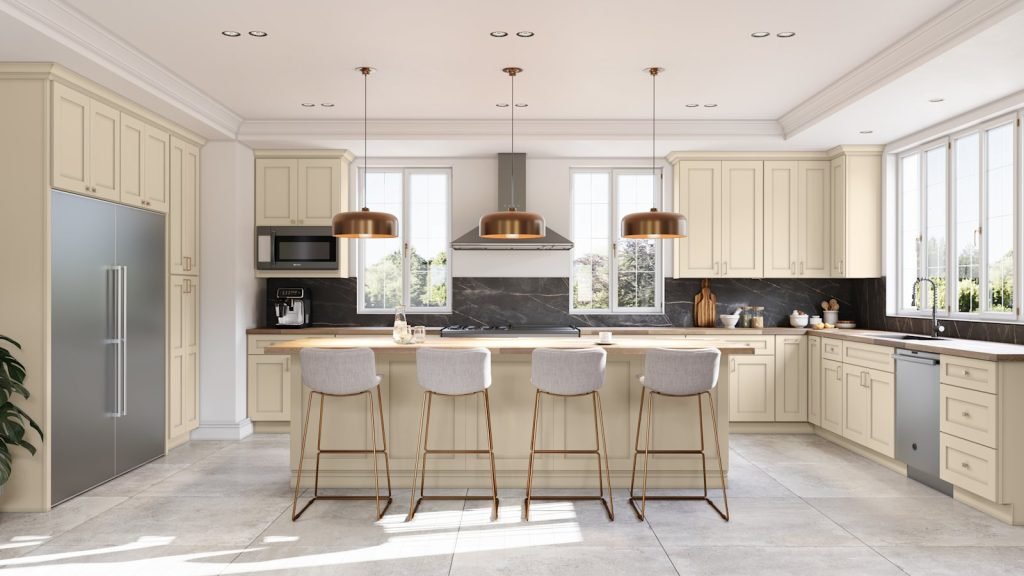 Macadamia Beige classic shaker kitchen cabinets with a dark backsplash, copper dome pendants and stainless appliances. Fabuwood Galaxy.
An ogee countertop edge is right for a traditional kitchen when the cabinets, trim, hardware, and countertop all carry enough detail to make the profile feel intentional. It can look out of place beside very plain slab doors, narrow shaker rails, or a minimalist kitchen designed around flat surfaces.
An ogee edge tends to work well with a raised-panel door, traditional shaker, decorative hood surround, or crown molding. Fabuwood’s Hallmark collection in the Value Premium series and the Metro collection in the Quest series may suit homeowners building a more traditional direction, depending on the selected finish and overall layout.
The countertop material matters too. Strong movement in quartzite or a veined quartz can make an ogee edge feel rich and layered, but a very busy pattern combined with ornate cabinetry can become visually crowded. Bring a cabinet door sample, a hardware sample, and the countertop selection together before finalizing the profile.
How much do countertop edge profiles cost in New Jersey?
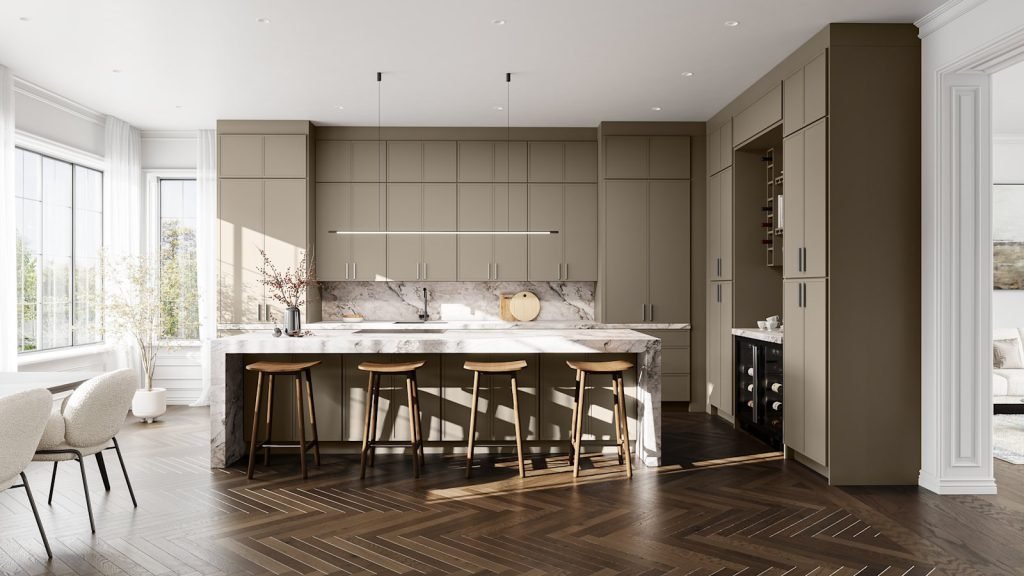 Oyster slim shaker kitchen cabinets with a contrasting charcoal island, a herringbone wood floor. Fabuwood Luna.
Countertop edge profile cost in New Jersey is part of the overall countertop fabrication and kitchen scope, not a reliable stand-alone number. At Savona Kitchen & Bath, a Silver kitchen package starts at $9,999 and includes semi-custom cabinetry, a countertop package, design consultation, material coordination, and delivery, with installation quoted separately.
A Gold Full Kitchen Package starts at $14,999 and includes semi-custom cabinetry, a countertop package, kitchen sink, design consultation, material coordination, delivery, and professional installation by Savona’s in-house team. Final pricing depends on layout, material selections, cabinet line, countertop choice, edge complexity, slab use, cutouts, and installation scope.
Both starting prices are package starting points, not quotes or averages. They exclude demolition, electrical work, plumbing rough-ins, flooring, tile, and structural modifications. Review the details of Savona’s kitchen remodeling pricing in New Jersey before comparing proposals, because one quote may include countertop fabrication or installation items that another lists separately.
Waterfall panels, mitered build-ups, complex curves, and detailed ogee work can require more fabrication than a standard eased edge. The practical way to compare options is to choose the slab first, confirm where seams and returns will fall, and then price the actual layout rather than relying on a generic edge-profile allowance.
What should New Jersey homeowners consider before choosing an edge?
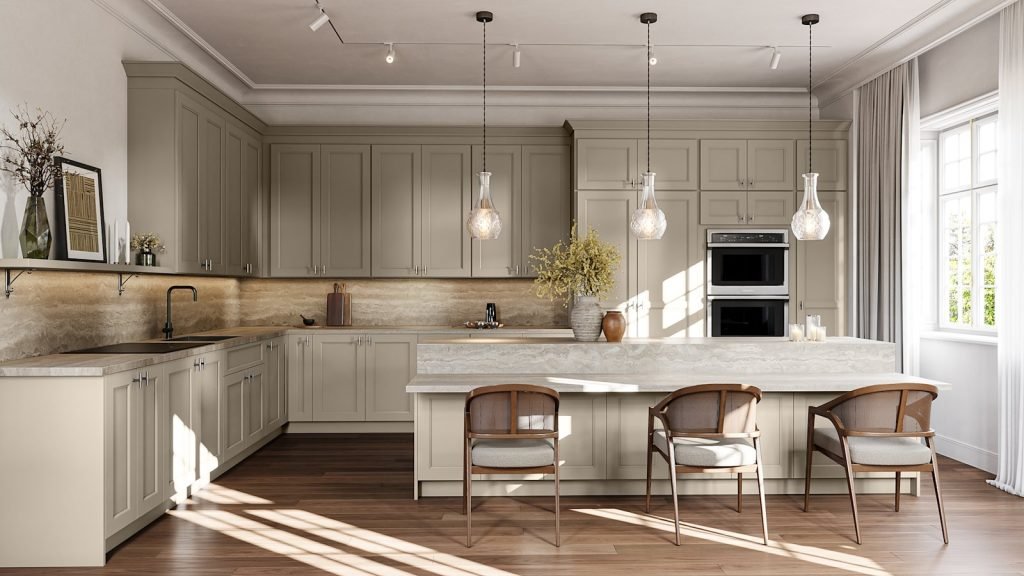 Oyster wide shaker kitchen cabinets with a matte black faucet and a herringbone floor. Fabuwood Nexus.
New Jersey homeowners should choose a countertop edge after confirming the cabinet style, countertop material, island design, and how the kitchen will be used daily. Humid summers and dry heated winters also make material selection, proper fabrication, and manufacturer care guidance more important for natural materials and wood cabinetry.
A large island in a closed or galley kitchen needs special thought. In many Central New Jersey homes, the layout is the limiting factor, so a waterfall end panel may not be the best use of space if it interferes with seating, appliance clearance, or cabinet access. If moving plumbing, electrical, walls, or structural elements becomes part of the project, permits are issued by the local township construction office under the New Jersey Uniform Construction Code.
For homeowners using quartzite, ask about the specific slab’s maintenance needs before choosing an elaborate edge. For quartz, focus on the edge shape and overall design because the surface is often selected for its consistent appearance and practical day-to-day use. The Tile Council of North America also provides industry resources that can help homeowners understand how adjacent tile and countertop materials should be planned as part of one finished kitchen.
Savona designs, supplies, and installs kitchens throughout Middlesex, Monmouth, Mercer, Somerset, Hunterdon, Union, and Ocean counties. If your project is on a deadline, quick-ship, next-day delivery, and RTA cabinet options are available, while full remodel timing is quoted by project scope.
Frequently asked questions
Countertop edge profiles are easiest to select after narrowing the countertop material and cabinet style, because those choices determine whether the room needs a crisp, rounded, decorative, or architectural edge. The questions below cover the edge decisions homeowners most often raise during kitchen planning.
Is an eased countertop edge better than a bullnose edge?
An eased countertop edge is better than bullnose for most contemporary and transitional kitchens because it looks cleaner and keeps the slab visually slim. Bullnose is better when you prefer a noticeably rounded edge or want to avoid a defined front corner. Both are practical choices for active kitchens.
Does an ogee countertop edge look dated?
An ogee countertop edge does not automatically look dated, but it is a traditional detail and should match the rest of the room. It looks appropriate with raised-panel cabinetry, crown molding, and classic hardware. In a minimalist slab-door kitchen, an eased edge usually creates a more coherent result.
Is a waterfall countertop edge worth it on an island?
A waterfall countertop edge is worth it when the island is a focal point and the slab pattern looks attractive continuing down the side. It is less necessary on a small island, a heavily interrupted layout, or a kitchen where budget should be directed toward cabinetry, appliances, or a better countertop material.
What countertop edge styles work with white shaker cabinets?
Eased and pencil-round countertop edge styles work especially well with white shaker cabinets because they keep the kitchen balanced rather than overly decorative. A white shaker kitchen with a soft gray quartz counter, satin nickel pulls, medium-tone wood flooring, and an eased edge feels bright and orderly without looking stark.
What countertop edge profile is best for a New Jersey kitchen?
An eased countertop edge is usually the best all-around choice for a New Jersey kitchen because it works across cabinet styles, cleans easily, and does not rely on a passing design trend. Homeowners in Green Brook, Piscataway, Bridgewater, and Basking Ridge can compare edge samples with full cabinet and countertop selections at the showroom.
Choose the edge after you choose the full kitchen palette
The best countertop edge profile is the one that supports the cabinet door, slab pattern, hardware, and layout without demanding attention for the wrong reason. An eased edge is the dependable choice for most kitchens, while bullnose, ogee, and waterfall details should be selected because they clearly improve the particular design.
Bring your layout or measurements to Savona Kitchen & Bath in Green Brook Township, or request a free kitchen estimate to discuss countertop samples, cabinet styles, and installation by Savona’s in-house team. Seeing the materials together is particularly useful for Central New Jersey homeowners deciding between a quiet practical edge and a statement island detail.


